How is AI used in business development?
AI is transforming business development by enabling smarter apps, personalized user experiences, and data-driven decisions. From mobile development to marketing and cloud scalability, AI boosts efficiency through automation, intelligent analytics, and real-time optimization. With tools like AI-generated code, predictive resource planning, and secure, scalable infrastructure, businesses can innovate faster, reduce costs, and deliver more adaptive, user-focused solutions. Working with experienced AI developers is key to building effective strategies and long-term success.
What is AI Business Development?
AI Business Development is the use of artificial intelligence to drive business growth by automating tasks, improving customer engagement, optimizing sales, and enabling smarter, data-driven decisions. It helps businesses work more efficiently and make better strategic choices to achieve their goals.
Global AI Market Size (2020–2030):
"The global artificial intelligence (AI) market has seen rapid growth in recent years, with its value jumping from $58.3 billion in 2020 to over $184 billion in 2024. According to Statista's AI market size forecast (2020–2030), it is expected to surpass $826 billion by 2030, reflecting a compound annual growth rate (CAGR) of over 35%."
Importance of AI for Business Development
The advancement of AI has a big impact on how organizations run. Businesses can automate procedures and perform effective data analysis by utilizing generative AI for business development. This capability leads to better customer interactions and decision-making, clearly showing how AI is transforming business development across various industries.
AI helps businesses grow by automating tasks, improving decision-making, and enhancing customer experiences. It streamlines operations, reduces costs, boosts efficiency, and allows teams to focus on higher-value work. From data analysis and content creation to sales, marketing, and cybersecurity, AI gives businesses a competitive edge in today’s market.

Enhanced Efficiency
Automation:
AI handles repetitive tasks, allowing employees to focus on more important and creative work.
Process Optimization:
AI improves how tasks and workflows are done, making operations quicker and more efficient.
Increased Productivity:
The productivity of companies using AI often increases by 20 percent on average, according to some reports.
Improved Decision-Making
Data Analysis:
AI quickly processes large amounts of data to find patterns and useful insights, helping businesses make smarter decisions.
AI-Powered Predictions
AI can forecast future trends and behaviors, so companies can plan ahead and stay ahead of the competition.
Risk Management:
AI helps spot and reduce risks like fraud or cyberattacks, keeping businesses safer and more secure.
Better Customer Experiences
Customized Customer Experiences
AI helps tailor experiences and recommendations to each customer, making them feel valued and more satisfied.
AI-Powered Customer Care:
AI powers chatbots and virtual helpers that are available anytime, helping customers quickly and easily.
Building Loyalty:
By learning what customers like and how they behave, AI helps businesses create stronger connections and keep customers coming back.
Cost Savings
Lower Operational Costs
AI helps reduce everyday business expenses by taking over repetitive tasks and making work faster and more efficient.
Reduce Errors and Waste
By using AI, businesses can minimize human errors and make more accurate decisions, which helps avoid costly mistakes and wasted resources.
Smarter Resource Management
AI helps businesses use their staff, time, and budget more wisely by showing what works best through smart data insights.
Increased Agility
Quick Decision-Making
AI helps businesses make faster and smarter choices by quickly analyzing data and offering real-time insights.
Adapts to Changes Fast
With AI, companies can quickly respond to market changes, customer needs, or new trends without delays.
Speeds Up Innovation
AI allows businesses to test new ideas, improve products, and bring updates to market faster than before.
Key Components of AI in Business
Business AI includes Machine Learning, Natural Language Processing (NLP), Deep Learning, Robotics, and Computer Vision. Through these technologies, businesses are able to automate tasks, make better decisions, and provide better experiences to their customers. AI in business also involves data management, technology integration, and continuous learning.
| Analytics of Data | Data analytics are essential for AI business development. Data analysis facilitates the discovery of patterns and consumer preferences. |
| Natural Language Processing (NLP) | Natural Language Processing (NLP), a key AI component for understanding human language, powers tasks like feedback analysis, customer service automation, and insight extraction. The NLP market is projected to reach $53.42 billion in 2025, growing at a 24.76% CAGR to hit $201.49 billion by 2031, with the U.S. leading at $15.21 billion in 2025. |
| Machine Learning | AI technologies rely on machine learning, which allows systems to improve automatically through experience. In 2021, Newsle dominated the machine learning market with an 88.71% share, ahead of TensorFlow and Torch. |
| Deep Learning |
Automation, predictive analytics, and improved customer experiences can be achieved with deep learning in AI business development. Using multiple layers of artificial neural networks, we can analyze large datasets. Text and image data can provide insights without extensive human intervention. |
| Robotics |
The integration of robotics and AI is advancing business development significantly. AI allows robots to learn, adapt, and perform tasks more efficiently. Integrated solutions improve customer experiences, decision-making, and automation. |
| Automation | Business procedures are streamlined by automation. Businesses can increase operational efficiency and decrease physical labour. |
Benefits of AI for Business Development
AI business development offers numerous advantages. These benefits lead to improved operational efficiency and customer satisfaction.

Increased Efficiency in Operations
- Automating repetitive tasks boosts productivity, reduces human error, and frees up employees to focus on strategic work.
- Streamlined processes and better resource allocation lead to more effective and efficient results.
Predictive Analytics for Smarter Decisions
-
Real-time data insights, predictive analytics, and enhanced reporting improve transparency and enable smarter, low-risk decision-making.
-
Data-driven strategies lead to more accurate trend forecasting and better overall outcomes.
Enhanced Customer Experience
-
AI-driven personalization—through behavior analysis, tailored recommendations, and targeted marketing—boosts engagement and customer satisfaction.
-
Personalized interactions and AI-powered support make customers feel valued and improve overall experience.
Cost Reduction through Automation
-
AI automation reduces labor and operational costs by minimizing errors, resource waste, and the need for additional workforce.
-
These efficiencies enable scalable growth and drive long-term profitability.
Real-Time Market Response
-
AI enables rapid adaptation to trends and data-driven strategy shifts.
-
Real-time monitoring and agility help businesses stay competitive and seize new opportunities.
Top Use Cases in AI Business Development
AI supports various business development areas by enhancing customer experiences, streamlining operations, and automating processes. Key uses include personalized suggestions, AI-driven customer support chatbots, generating leads, and forecasting maintenance needs.
Predictive Analytics
- AI uses historical data to forecast trends and emerging customer preferences, enabling smarter demand planning.
- Predictive models help optimize inventory and marketing strategies, leading to more accurate decisions and improved results.

Success Story – Amazon
"Predictive analytics is used by Amazon to forecast future purchasing trends by analysing past purchase data. Sales and customer satisfaction rise as a result of their ability to suggest products to clients based on their interests."
AI-Powered Marketing Personalization
- AI identifies distinct customer segments, allowing for personalized messaging that boosts campaign performance.
- Targeted outreach improves conversion rates and helps allocate marketing resources more effectively

Success Story – Netflix
"Netflix uses AI to segment its audience based on users' preferences and patterns. This allows them to recommend content and personalise marketing messages, which increases engagement and user retention."
Customer Service and Support:
- AI chatbots provide 24/7 support, delivering instant responses and reducing wait times to enhance customer satisfaction.
- They efficiently handle routine inquiries, allowing businesses to scale customer service without added costs.

Success Story – Sephora
"Sephora has included an AI chatbot into their mobile app and website to offer round-the-clock client service. By quickly answering questions about goods and services, this has greatly raised revenue and improved consumer satisfaction."
Sales Forecasting
- AI-driven sales forecasting enables accurate predictions, helping businesses allocate resources and prepare for seasonal trends.
- Improved planning and data-based insights enhance operational efficiency and strengthen sales strategies.

Success Story – Walmart
"Walmart analyzes sales data and projects future demand using AI-driven sales forecasting. Particularly during seasonal peaks, this has enabled them to enhance operating efficiency, minimize waste and optimize inventory management."
Lead Generation
- AI analyzes data to identify high-potential leads and streamline lead qualification, boosting efficiency.
- Prioritized outreach and better targeting result in improved conversion rates and stronger sales performance.

Success Story – LinkedIn
"LinkedIn uses AI-driven algorithms to analyze user data and activity to help businesses in finding and targeting new customers. With insights and recommendations that help them interact more effectively with high-quality leads, their Sales Navigator system has significantly improved their lead generation efforts."
What Are the Best AI Business Development Tools?
Top AI business development tools include Salesforce Einstein (AI-driven sales and marketing insights), HubSpot (tracks campaign performance), Zoho CRM (streamlines customer interactions with AI), Tableau (provides smart data visualization), and Google Analytics (researcher behavior). These tools use AI to improve sales, automate marketing, and deliver actionable data insights.
|
Salesforce Einstein |
AI is incorporated into customer relationship management via Salesforce Einstein. It offers information that improves marketing and sales initiatives. |
|
HubSpot |
HubSpot enhances marketing initiatives with AI. It boosts engagement and helps in performance measurement for firms. |
|
Tableau |
Tableau provides strong tools for data visualization. Interactive dashboards can be made by businesses to track important metrics. |
|
Google Analytics |
Google Analytics gives you information about how people behave. Businesses are able to examine traffic trends and enhance their internet visibility. |
|
Zoho CRM |
Zoho CRM incorporates AI features for customer management. It helps businesses streamline interactions and improve satisfaction. |
How to Use AI for Startup Business Development
AI accelerates startup growth by automating repetitive tasks, enhancing customer experiences, and optimizing data analysis. It supports content creation, sales, customer service, and market research—enabling faster, smarter scaling.

Identifying Specific Needs for AI Integration
- Identify business challenges, customer needs, and areas for automation to uncover where AI can add value.
- Evaluate existing processes and set clear goals to guide effective AI implementation.
Choosing the Right AI Tools for Startups
-
Choose AI tools that align with business goals, offer scalability, and integrate smoothly with existing systems.
-
Weigh costs against benefits and prioritize ease of use and reliable customer support.
Collecting Quality Data for Training AI Models
- Collect accurate, consistent, and relevant data from diverse sources while ensuring privacy and compliance.
- Regularly update data to capture new patterns and improve AI performance.
Implementing AI Solutions in Business Processes
- Integrate AI into current workflows, provide employee training, and monitor for challenges during implementation.
- Use feedback and results to continuously improve and refine AI processes.
Monitoring and Evaluating AI Performance
- Define clear KPIs and regularly assess AI performance against them.
- Use performance data and user feedback to refine strategies and continuously train AI systems.
Applications for AI in Business Development
AI drives business development across multiple areas by boosting customer engagement, automating tasks, enhancing data analysis, and refining marketing. It personalizes experiences, manages inventory, predicts demand, and handles routine activities like data entry and scheduling.
Healthcare
-
AI improves diagnostic accuracy and patient management through data analysis and predictive analytics.
-
It streamlines healthcare administration, supports telemedicine, and enables personalized treatment for better patient outcomes.
Finance
-
AI detects suspicious transactions and enhances risk assessment with predictive models.
-
It automates compliance, strengthens customer verification, and supports accurate financial forecasting for better planning.
Retail
-
AI personalizes customer experiences, optimizes inventory, and improves service with chatbots.
-
It boosts conversions through targeted marketing and adjusts pricing based on real-time market trends.
Manufacturing
-
AI enhances supply chain efficiency, automates production, and enables predictive maintenance to reduce downtime.
-
It supports continuous improvement through data analysis and improves workplace safety with smart monitoring.
Education
-
AI creates personalized learning paths and provides tailored tutoring through data-driven insights.
-
Predictive analytics helps identify at-risk students, while engagement tools boost learning outcomes.
The AI Business Development Process
The AI business development process uses artificial intelligence to automate and improve key growth tasks like lead generation, sales, and decision-making. It starts by identifying where AI can help, setting clear goals, choosing the right tools, and using data to train the system. Once in action, AI delivers insights, boosts efficiency, and helps businesses grow faster and smarter.
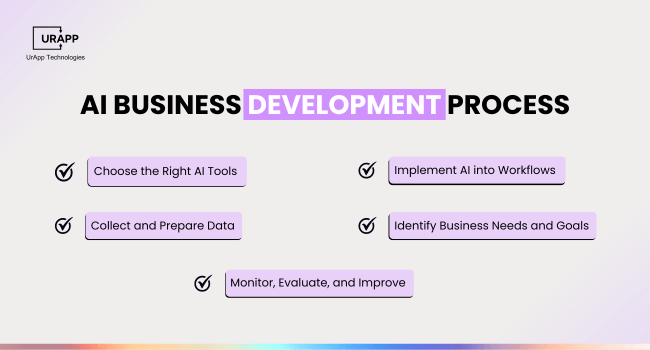
Identify Business Needs and Goals
- Spot the problem areas: Look at where your business can improve with AI, like customer support or sales.
- Set clear objectives: Decide what you want to achieve—faster service, fewer errors, or higher profits.
Choose the Right AI Tools
- Find tools that fit your needs: Pick AI solutions that solve your problems and are simple to use.
- Check compatibility: Make sure they work smoothly with your current systems and can grow with your business.
Collect and Prepare Data
- Gather the right data: Collect useful business information that AI can learn from.
- Clean and organize it: Ensure the data is accurate, consistent, and safe to use.
Implement AI into Workflows
- Integrate with daily tasks: Add AI where it can help most—like automating tasks or answering customers.
- Train your team: Help employees understand and use the new AI tools confidently.
Monitor, Evaluate, and Improve
- Track AI performance: Use clear metrics to see how well the AI is doing.
- Keep improving: Use results and feedback to fine-tune and grow the system over time.
Technology Used in AI Development
Generative AI for business development relies on various technologies. These technologies enable the creation of innovative solution
Machine Learning
- Machine learning algorithms improve with exposure to more data.
- Supervised learning trains models on labeled datasets.
- Unsupervised learning identifies patterns in unlabeled data.
- Reinforcement learning optimizes decision-making through feedback.
- Machine learning applications span various industries.
Natural Language Processing
- NLP enables machines to interpret and respond to human language.
- Sentiment analysis gauges customer emotions from text.
- Chatbots leverage NLP for effective communication.
- Language translation tools enhance global communication.
- Text summarization improves information accessibility.
Computer Vision
- Machines can analyze photos and movies via computer vision.
- Security and user authentication are improved by facial recognition.
- Object detection improves inventory management and logistics.
- Image classification assists in content organization.
- Augmented reality applications enhance user experiences.
Deep Learning
- Deep learning mimics human brain functions through neural networks.
- Convolutional neural networks excel in image processing tasks.
- Recurrent neural networks are ideal for sequence prediction.
- Deep learning applications span healthcare, finance and more.
- Enhanced accuracy in predictions drives innovation.
Cloud Computing
- On-demand access to computer resources is made possible via cloud computing.
- Businesses can expand without infrastructure limitations due to scalability.
- AI apps can make use of cloud-based processing and storage resources.
- Cost-effective solutions reduce the need for physical hardware.
- Cloud computing enhances collaboration and data sharing.Overview of Key Technologies
Current Statistics on AI in Business Development
AI business development continues to grow rapidly. Understanding current statistics helps gauge its impact and potential.
Market Growth Statistics from Statista
The market for AI technologies is vast, amounting to around 244 billion U.S. dollars in 2025. It is expected to grow well beyond that to over 800 million U.S. dollars by 2030.
AI Market Growth Projections (2025–2030)
Source: Statista
Investment Trends in AI Solutions
-
Recent years have seen a sharp rise in investment in AI technologies.
-
Businesses recognise the importance of AI technology.
-
Generative AI for business development attracts substantial funding.
-
AI is a top priority for businesses' strategic planning.
-
Increased funding generates more creative applications
Job Creation Projections in AI Sectors
-
The AI sector is projected to create 69 million new jobs after the AI transition.
-
AI for business development will drive job growth in various fields.
-
83 million jobs are expected to be lost in the next five years due to AI.
-
46% of office and administrative tasks are vulnerable to automation.
-
AI can already automate 70% of workforce tasks according to McKinsey.
Efficiency Improvements Reported by Businesses Using AI
-
AI improves productivity by automating processes.
-
Making better decisions is a result of data analysis.
-
Predicting outcomes improves efficiency and resource allocation.
-
AI reduces errors and speeds up processes.
-
Improved performance results in cost savings.
UrApp Tech - A Leader in AI Development:
Conclusion:
AI business development plays a transformative role in app development. Companies like UrApp Tech lead the way in integrating AI solutions. Embracing AI fosters innovation and drives growth. If you want to add your own innovative solutions, Contact UrApp Tech today. Together, you can harness the power of AI to drive your business forward.