Flutter vs. React Native - Which is better in 2025
Building your next app in 2025?
Choosing the wrong framework could cost you months of work and a fortune in development. Here’s how Flutter and React Native compare in performance, cost, and real-world usage, so you can decide wisely.
 What is Flutter?
Flutter is Google's open-source framework for building native apps across iOS, Android, web, and desktop using a single Dart codebase. It uses a widget-based architecture with customizable UI components for creating visually appealing applications. This eliminates the need for separate platform-specific codebases, reducing development time and costs. Flutter compiles to native code, ensuring high performance across all platforms. The framework enables consistent user experiences while maintaining access to platform-specific features.
 What is React Native?
React Native is an open-source framework created by Meta that allows developers to build mobile applications for both iOS and Android using JavaScript. Unlike traditional web-based solutions, it uses native components to deliver a real mobile app experience. By enabling code sharing across platforms, React Native speeds up development while maintaining a native look and feel. It’s a flexible, efficient tool that helps developers create high-quality apps using familiar web technologies.
Flutter Vs React Native: The Difference
| Aspect | Flutter | React Native |
|---|---|---|
| Programming Language | Uses Dart, created by Google. It's fast, strongly typed, and supports both AOT and JIT. Might be new for some, but easy to pick up if you're familiar with object-oriented programming. | Uses JavaScript (and often TypeScript). Very popular and easy to use, especially for web developers. |
| Performance | Excellent performance. Compiles directly to native code and uses its own rendering engine, making it ideal for smooth animations and heavy UIs. | Good performance but depends on a bridge between JavaScript and native code, which can slow things down in complex apps. |
| UI & Design Flexibility | Highly customizable. Everything is a widget, allowing pixel-perfect designs that look consistent across platforms. | Uses actual native components, so apps look and feel like native ones. Custom UIs might need more effort. |
| Development Cost | Fast to develop with hot reload and built-in widgets. One codebase for all platforms saves time and money. | Also fast to develop. JavaScript familiarity and a large ecosystem make it easier and quicker for many teams. |
| Community and Ecosystem | Supported by Google and growing quickly. Plenty of tutorials, packages, and resources. | More mature community with a huge number of libraries, tools, and developer support. |
| Learning Curve | Slightly steeper if you're new to Dart or Flutter’s layout system. Great docs and resources help ease the process. | Easier to learn if you know JavaScript or React. Perfect for web developers moving into mobile. |
| Job Market | Demand is rising fast, especially in startups and projects needing beautiful UIs and fast performance. | Has a larger job market for now due to its longer history and JavaScript base. |
| Google Integration | Works seamlessly with Google services like Firebase, Google Maps, and more. | Can also connect to Google services but may need extra configuration or libraries. |
| App Size | Usually larger because it includes its own rendering engine. | Typically results in smaller app sizes, though it depends on the project. |
Flutter vs React Native: Which is better?
There’s no one-size-fits-all answer. Flutter is better for high-performance and visually rich apps. React Native is better if you want faster development and already use JavaScript. The best choice depends on your project needs and team skills.
Flutter:
-
Offers very fast and smooth performance.
-
Creates consistent app designs on all platforms.
-
Uses Dart language, which might take some time to learn.
-
Works well if you want one codebase for mobile, web, and desktop.
React Native:
-
Uses JavaScript, so it’s easier if you or your team already know JS.
-
Has a big community with lots of support and tools.
-
Lets you build apps faster, especially if you’re familiar with JavaScript.
-
Sometimes apps can look a bit different on different devices.
React Native vs Flutter: Popularity by Stats and Trends
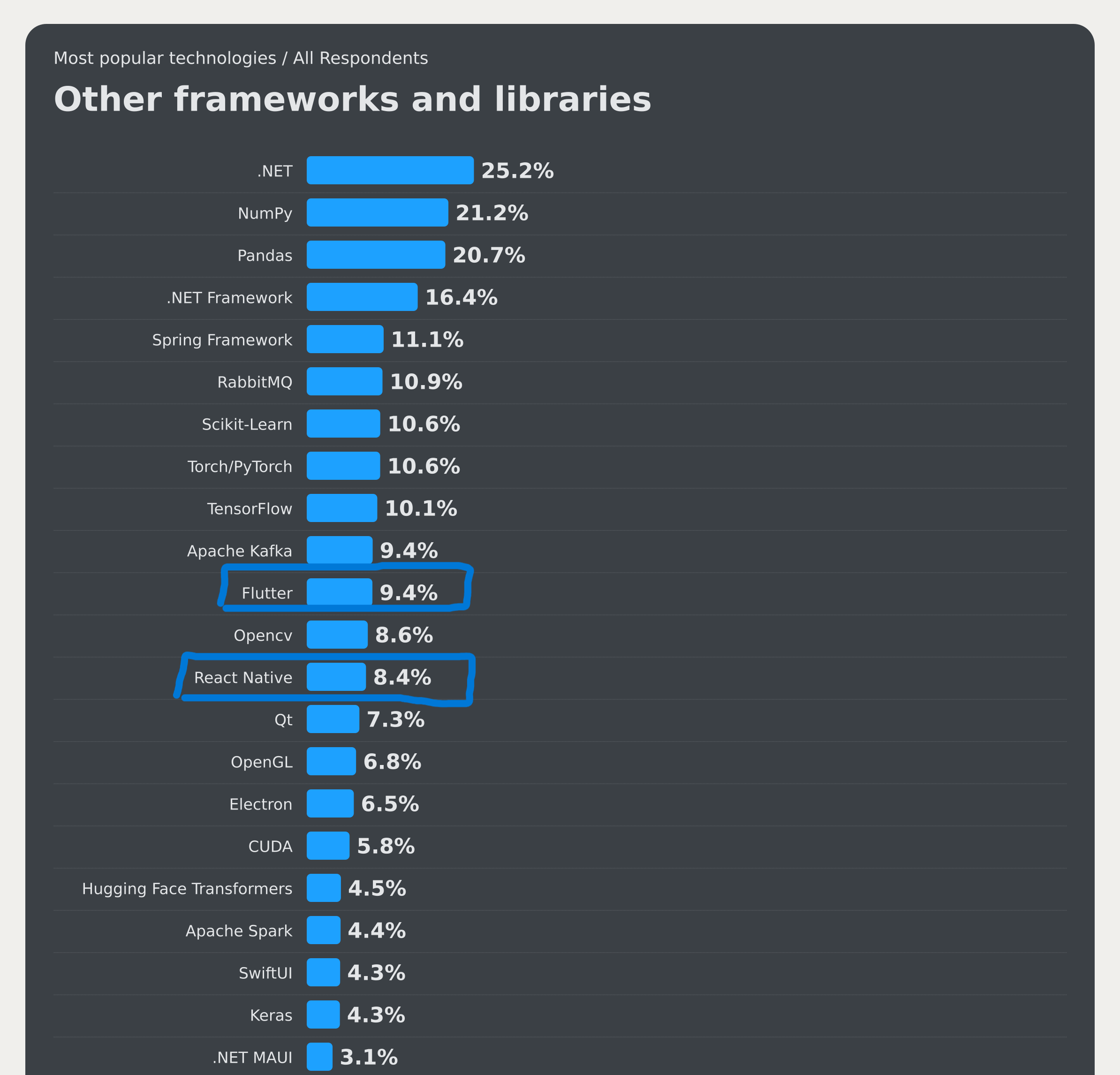
In the 2024 stack overflow survey, Flutter and React native are very close in popularity, as you can see from the statistics below:
In a 2023 developer survey by Statista, 46% of developers use Flutter as their cross-platform mobile framework. The use of React Native is 32%, while Xamarin and Unity are much less popular.
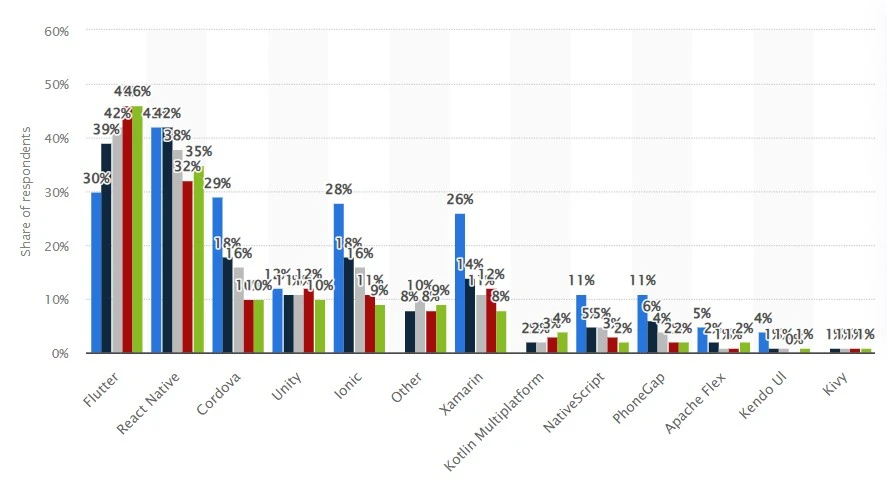
Source: Statista
The number of Stack Overflow questions related to Flutter increased from 0% in 2015 to 3% in 2024, while React Native steadily increased to 1.8% in 2016. The rapid rise of Flutter started after its 2018 beta, despite React Native's 3-year lead.
Developer satisfaction is higher with Flutter (60.6% vs 56.5% "admired"), but job markets are dominated by React Native.
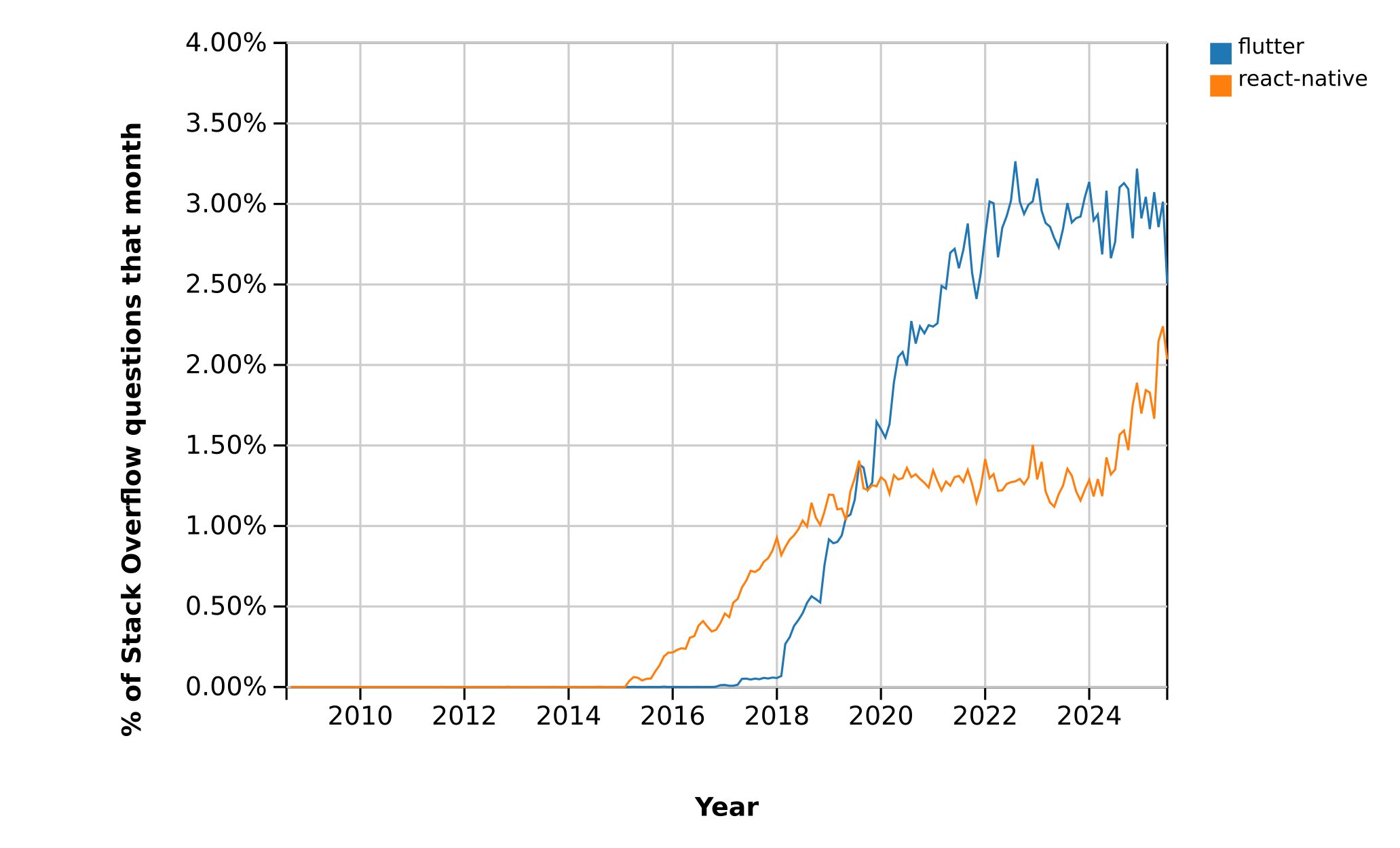
Source: Github
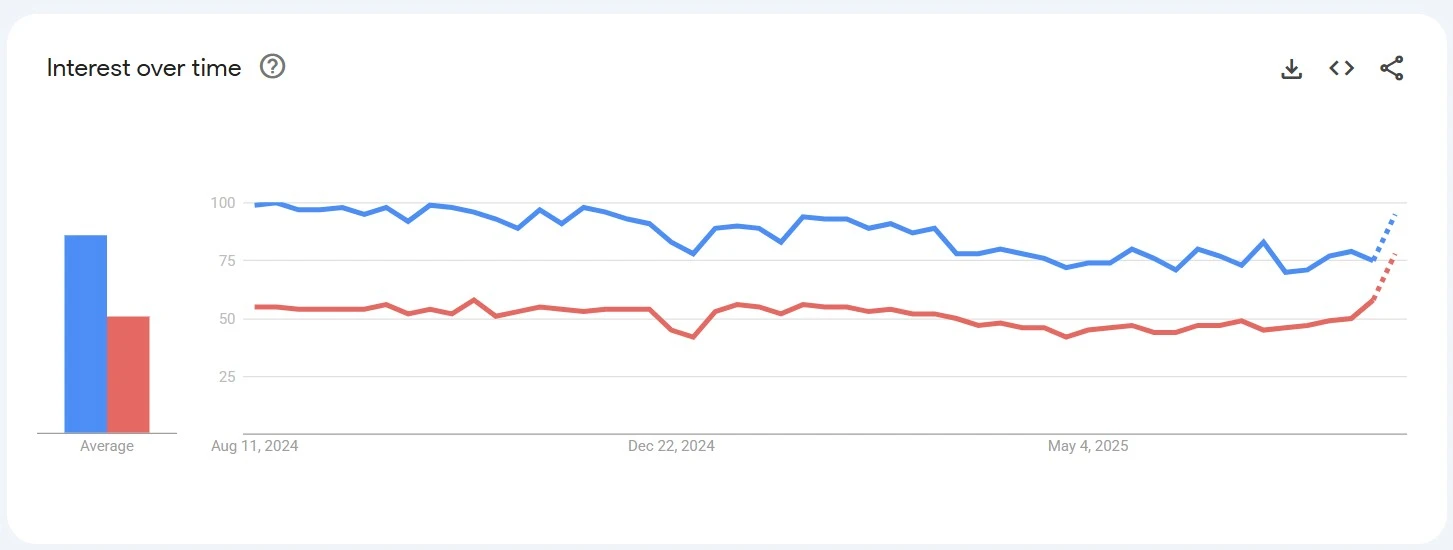
According to Google Trend, in the past 12 months, Flutter (blue) has outpaced React Native (red) with a relative score of 75-100. Globally, Flutter maintains roughly 2x more search volume than React Native.
Flutter Vs React Native: Real World Examples
Flutter Use Cases
Birch Finance (Expense Tracker)
- Flutter helps it show your expenses and charts in a clear, colorful way, making budgeting simple for anyone.
Philips Hue App
- Flutter allows the app to control smart lights instantly, so adjusting your room’s lighting feels effortless.
React Native Use Cases
- React Native lets Instagram push new features like Stories or Reels fast without slowing your app down, so you can scroll, like, and post smoothly.
Walmart
- Uses React Native to keep the shopping app quick and reliable, helping you find deals and check out without frustration.
Key Takeaways
- 46% of cross-platform developers use Flutter, while 32% use React Native, making them the most popular frameworks in 2025.
- Flutter compiles directly to native code for smoother animations, pixel-perfect UIs, and consistent performance across iOS, Android, web, and desktop.
- React Native uses JavaScript and native components, enabling faster builds and easier adoption for teams already in the JS/React ecosystem.
- Flutter apps may be larger in size but offer higher design consistency, while React Native apps are typically smaller with a more native feel.
- Developer satisfaction is higher with Flutter (60.6% admired) compared to React Native (56.5% admired), though RN currently has a larger job market.
- Framework choice depends on team skills, performance goals, budget, and target platforms—both are evolving rapidly in 2025.
Want a Visually Stunning, High performance App?
Talk to our Flutter Experts TodayConclusion
There are a few highly effective frameworks for developing cross-platform native mobile apps: Flutter and React Native are their strongest sides. Compared to its competitors, it has better performance settings and customization, making the app very helpful in graphics and animation. More opportunities and work rationality for React Native include its relatively low cost, which calls for quicker development and to reach more people.
If you want to leverage the power of Flutter for your next project, partnering with a trusted Flutter app development company like UrApp Tech can help you build high-performance, visually stunning apps that work seamlessly across platforms. Our expertise in Flutter application development ensures your project gets the attention, speed, and polish it deserves.