Understanding the Difference Between Conversational AI and Generative AI
Artificial intelligence is changing and improving various areas of business. A lot of progress has been seen in AI and today conversational AI and generative AI are major branches. These technologies play different roles in different sectors. Businesses that want to benefit from AI must understand that in the debate of Conversational AI vs Generative AI, which one is the perfect choice.
Natural human-like communication is at the heart of Conversational AI. Because of Natural Language Processing, machines can listen to and reply to people. Unlike the other types, generative AI creates things such as articles, images and music of its own. This blog dives into what conversational AI vs generative AI are and outlines their advantages and disadvantages.
Key Statistics
-
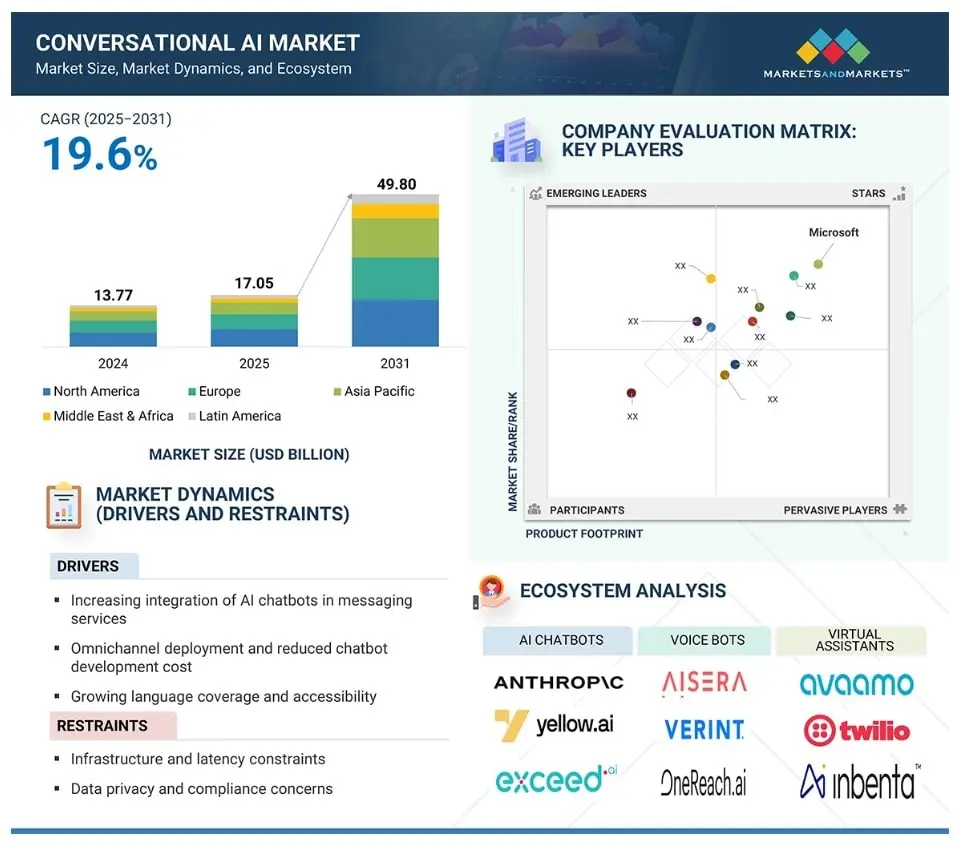
The conversational AI market is set for significant expansion and is expected to grow from USD 17.05 Billion in 2025 to USD 49.05 Billion by 2031
-
Generative AI on the other hand is set to reach US$66.89bn in 2025 and further grow to 36.99%, with a market value of US$442.07bn by 2031.
These technologies developed rapidly and are becoming more and more important in today's world.
What is Conversational AI?

The name conversational AI is given to technologies that enable machines to interact with humans much like we interact with one another. It uses NLP to read what a user types and deliver useful answers. Conversational AI backs chatbots and virtual assistants which make it simpler for businesses to help and interact with their customers.
Example of Conversational AI
Popular examples of conversational AI include
- Chatbots used in customer service
- Voice assistants like Siri and Alexa
- Messaging apps with automated responses
- Interactive voice response systems in call centers
- Social media bots that engage users
These tools showcase how conversational AI enhances user experience by providing quick and accurate responses.
How Conversational AI Works?
Conversational AI uses Natural Language Processing (NLP) and Machine Learning (ML) to understand what people say and respond in a natural, helpful way. It learns from real conversations and keeps improving over time, making interactions feel more human and personalized.
-
Natural Language Processing (NLP):
This helps the AI understand and make sense of human language—both written and spoken—so it can respond in a way that feels natural.
-
Machine Learning (ML):
ML allows the system to learn from past conversations and user behavior, so it gets smarter and more accurate over time.
-
Speech Recognition:
This technology converts spoken words into text, enabling voice-based interactions like talking to a virtual assistant or smart speaker.
-
Contextual Understanding:
Conversational AI can remember details from previous interactions. This means it can continue a conversation smoothly and give more personalized, relevant responses.
What is Generative AI?

Generative AI includes algorithms designed to develop new material from trends found in existing data. With the help of machine learning, this technology can create text, images, music and similar types of content. Generative AI’s ability to create unique works makes it useful across different creative areas.
Example of Generative AI
Examples of generative AI include
-
Text generation tools like OpenAI's GPT-3
-
Image creation platforms such as DALL-E
-
Music composition software that generates unique melodies
-
Video game design tools that create environments and characters
-
3D modeling applications that produce realistic objects
These examples highlight the versatility of generative AI in producing innovative content.
How Generative AI Works?
Generative AI uses machine learning to study patterns and relationships in large datasets—like text, images, or code. Once trained, it creates new, original content based on what it has learned. This is how tools like ChatGPT or image generators produce human-like responses, designs, or ideas that feel natural and relevant.
Generative AI operates using several key components
-
Deep Learning Models:
These models study large amounts of data to find hidden patterns and use that knowledge to create new content, such as text, images, or sounds. They are the foundation behind many advanced AI applications.
-
Neural Networks:
Inspired by how the human brain works, neural networks are systems made up of layers of connected nodes (like neurons). They help AI process complex information, recognize patterns, and make decisions much like humans do.
-
Reinforcement Learning:
This is a way for AI to improve by learning from its own experiences. The AI tries different actions and receives feedback or rewards, helping it to gradually refine its responses and make better decisions over time.
By using such technologies, generative AI can make content that looks very much like what humans make.
Main Differences Between Conversational AI vs Generative AI
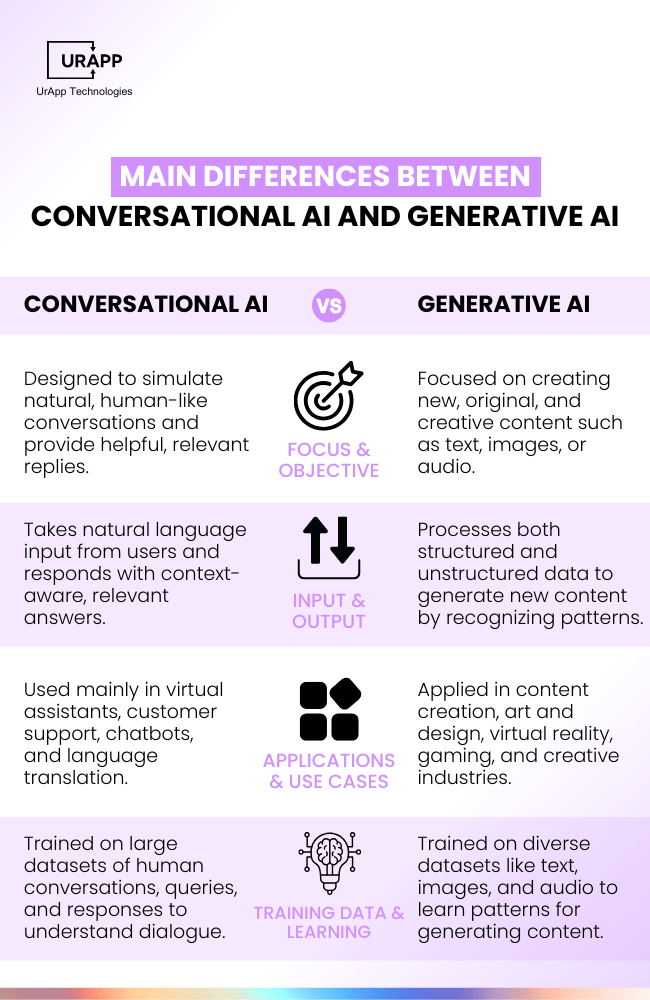
Feature of Conversational AI vs Generative AI
|
Feature |
Conversational AI |
Generative AI |
|
Purpose |
Facilitates human-like interactions |
Creates original content |
|
Input Type |
Text and speech |
Data patterns |
|
Output Type |
Responses to queries |
New content like text or images |
|
Use Cases |
Customer support, virtual assistants |
Content creation, design, music |
|
Technology |
Natural language processing |
Machine learning and deep learning |
Use Cases for Conversational AI
-
Customer Support
Automating responses to frequently asked questions can improve efficiency and reduce wait times.
-
Sales Assistance
By making suggestions based on user preferences, chatbots can assist clients with the purchasing process.
-
Feedback Collection
Real-time client feedback collection via conversational AI enables companies to make rapid changes.
Use Cases for Generative AI
-
Content Creation
Writers can save time by using generative AI to create blog entries, articles and marketing copy.
-
Art and Design
Artists can use generative AI to create unique visuals or design elements.
-
Music Composition
AI can be used by musicians to help with songwriting or to create original melodies.
Conversational AI's advantages
For organizations, conversational AI has many benefits. They include
-
Enhanced Customer Engagement
Conversational AI improves interaction quality, making customers feel valued.
-
24/7 Availability
Automated systems provide support around the clock, improving customer satisfaction.
-
Cost-Effectiveness
Operational costs are reduced when fewer human agents are required.
-
Customization
Customised answers improve user satisfaction and foster brand loyalty.
-
Scalability
Increased enquiries can be handled by businesses without hiring more employees.
Real-World Applications of Conversational AI
- Retail
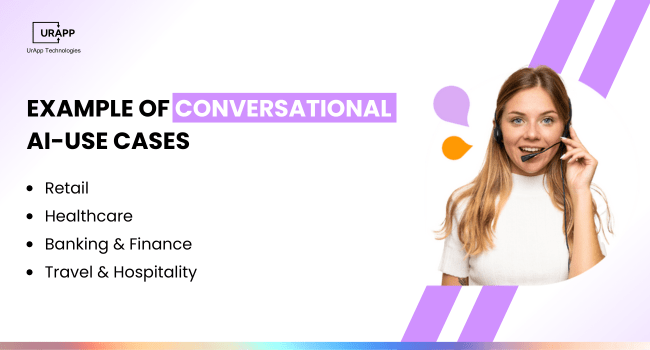
In retail, AI-powered chatbots guide customers through product searches, answer questions about availability or features, and help with order tracking and returns. This personalized support enhances the shopping experience and boosts customer engagement, helping businesses increase sales and build loyalty.
-
Healthcare
Virtual assistants in healthcare help patients easily schedule appointments, get reminders, and even provide basic medical advice or answer health-related questions. This improves access to care and saves time for both patients and medical staff.
- Finance and Banking
In finance, chatbots assist customers with tasks like checking account balances, making transactions, and answering common banking questions. They offer quick support 24/7, reducing wait times and improving customer satisfaction.
- Travel and Hospitality
Conversational AI in travel helps users book flights, reserve hotel rooms, and get real-time travel updates through chat or voice. It makes planning trips smoother and provides instant assistance anytime, anywhere.
Limitations of Conversational AI
Despite its benefits, conversational AI has limitations. These challenges include
-
Complex queries
Complex or tricky questions can be difficult for conversational AI to understand.
-
Emotional Intelligence Absence
Miscommunications may occur because machines cannot fully comprehend human emotions.
-
Limited Context Awareness
AI may fail to remember previous interactions, affecting continuity.
-
Dependence on Data Quality
Poor data can lead to inaccurate responses.
-
Security Concerns
Data privacy issues may arise if not properly managed.
Limitations of Generative AI
Generative AI has its own set of limitations. These challenges include
-
Quality Control
Generated content may require human oversight for quality assurance.
-
Potential for Misuse
Generative AI can create misleading or harmful content if misused.
-
Ethical Concerns
Issues arise regarding authorship and ownership of AI-generated content.
-
Complexity of Implementation
Developing generative AI solutions can be resource-intensive.
-
Data Dependency
The quality of output relies heavily on the data used for training.
When Should Businesses Use Conversational AI vs Generative AI?
Choosing conversational AI vs generative AI depends on business needs. Consider the following scenarios:
| Use Conversational AI when | Use Generative AI when |
|
You aim to enhance customer support. |
You need to create original content. |
|
Your focus is on improving user engagement. |
Your goal is to innovate in product design. |
|
You require real-time responses to inquiries. |
You seek to automate content creation processes. |
Businesses may choose the right technology to deploy by having a thorough understanding of these use cases.
Conversational E-Commerce and AI
Conversational commerce refers to the use of conversational AI to facilitate online shopping experiences. This approach allows customers to interact with brands through chatbots or voice assistants. By integrating conversational AI into e-commerce platforms, businesses can enhance the shopping experience.
Benefits of AI in E-Commerce
-
Personalized Recommendations
AI can suggest products based on user preferences.
-
Streamlined Transactions
Customers can complete purchases through simple conversations.
-
Improved Customer Support
Instant assistance helps resolve issues quickly.
-
Increased Engagement
Interactive experiences keep users engaged and encourage sales.
-
Data Collection
AI gathers valuable insights into customer behavior for future marketing strategies.
AI in App Development
Developers can employ conversational AI and generative AI in app development that offer personalized interactions and generate unique content, improving overall usefulness and user satisfaction.
Benefits of AI in App Development
-
Enhanced User Experience
AI can tailor app functionalities to individual user preferences.
-
Improved Performance
AI-driven analytics can optimize app performance based on user behavior.
-
Automation
AI can automate repetitive tasks within the app, improving efficiency.
AI Business Development
Employing AI business development techniques enables organisations to enhance decision-making and optimize operations. Businesses may effectively expand and adapt in a competitive environment by implementing generative AI for content generation and conversational AI for consumer interactions.
Strategies for AI Business Development
-
Implementing AI Tools
Leverage AI tools to enhance productivity and efficiency across departments.
-
Training Employees
Invest in training initiatives that help staff in learning and making good use of AI technologies.
-
Monitoring Trends
Stay updated on AI trends to identify new opportunities for innovation.
Brands That Used Conversational AI and Generative AI Solutions
Several brands have successfully implemented conversational AI and generative AI solutions.
Examples include:
-
Sephora
Uses conversational AI to assist customers in finding beauty products.
-
H&M
Implements chatbots to enhance customer support and streamline shopping experiences.
-
OpenAI
creates GPT-3 and other generative AI tools for a range of uses.
-
Adobe
Utilizes generative AI in design software to create unique graphics.
-
Netflix
Employs AI to generate personalized content recommendations for viewers.
They represent how generative and conversational AI are making a difference for customers and businesses.
Finding the Best Partner for Creating Conversational AI Systems
Implementation will be successful if the right solution provider is chosen. Be sure to look at the following points as you pick a partner.
-
Expertise
Look for providers with experience in conversational AI development.
-
Customization
Ensure the provider can tailor solutions to meet your specific needs.
-
Support
Assess the level of ongoing support and maintenance offered.
-
Technology Stack
Evaluate the technologies used in their solutions.
-
Client Testimonials
Examine case studies and prior client comments.
Businesses may develop successful conversational AI experiences that improve consumer engagement by collaborating with a reliable supplier.
Conclusion
All in all, organizations should understand the basics of conversational AI vs Generative AI. Conversational AI helps create natural interactions, whereas generative AI aims to design special material. These technologies work best in different situations because they have their own pros and cons. The right use of these technologies helps companies to enhance what consumers experience and encourage new advancements.
Contact UrApp Tech if you are planning to set up your own AI solutions in your company. With our AI Development Services, we will help you apply AI strategies that benefit your business.